

Overcooking salmon can lead to a certain kind of disappointment. You are aware of the time. The fish goes opaque, the white albumin starts pushing through the surface like wax, and what was supposed to be the centerpiece of dinner turns into something dry and apologetic. Anyone who has cooked fish more than a few times has lived through this. It’s why so many home cooks quietly give up and order salmon only when they’re out.
Which is part of why the slow-roasted method has been getting so much attention lately. It isn’t new, exactly. Cooks have been pulling fish through low ovens for decades. But the version championed by Alli Berkey at America’s Test Kitchen, refined through what sounds like a slightly obsessive round of testing between 170 and 350 degrees, seems to have struck something. The sweet spot landed at 250 degrees for an hour. Not glamorous. Not fast. Just dependable.
| Recipe & Source Information | Details |
|---|---|
| Featured Method | Slow-Roasted Salmon (low-temperature oven technique) |
| Originating Source | America’s Test Kitchen, April 2023 |
| Developed By | Alli Berkey, professional kitchen veteran |
| Optimal Oven Temperature | 250°F for farm-raised salmon |
| Cooking Time | Roughly 60 minutes for a 2½-pound fillet |
| Variation Source | The Mediterranean Dish, Suzy Karadsheh |
| Notable Chef Adaptation | Michael Symon, from Fix It With Food, featured by the Arthritis Foundation |
| Recommended Cut | Center-cut fillet, pin bones removed |
| Wild Salmon Adjustment | 45–50 minutes cooking time |
| Serving Yield | About six people |
| Core Ingredients | Salmon, salt, olive oil (additions optional) |
What’s interesting is how the technique gets described by the people who use it. Berkey talks about silky, buttery texture. The Mediterranean Dish’s chef, Suzy Karadsheh, calls the outcome “almost custardy,” which is an odd term to describe fish until you’ve tried it. Michael Symon describes his version as the sexiest salmon ever. Symon has the kind of restaurant background that doesn’t typically translate to weeknight cooking. For what is basically salmon, salt, and a low oven, that is a lot of words.
I believe the method’s appeal is that it eliminates the most stressful aspect of cooking fish. There may be a ninety-second window between flawless and ruined at higher temperatures. That window stretches to a forgiving angle at 250 degrees. The outcome is the same whether you pull the fish a bit early or a bit late. Berkey stated it simply. The fish is more difficult to overcook and has a larger window of ideal doneness. This is the kind of statement that ought to be printed on the inside of every oven door.
Even though no one wants to acknowledge it, the smell question is important. A small kitchen is filled with the lingering fish smell that clings to dish towels for days when salmon is seared in a hot skillet. It is mostly avoided by slow-roasting. The technique has a quietness to it that fits the way most people actually cook on a Tuesday night, both literally and in terms of effort.
With garlic, thyme, and baby potatoes all combined in one pan, Karadsheh’s version has a Mediterranean flavor. With honey, Dijon, and a marinade that is applied to the fish for an hour or two before it is heated, Symon’s tends to be sweeter. As soon as the fish is removed, Berkey finishes hers with a lemon and chive vinaigrette that mixes with the dish’s juices. Though the underlying logic is the same, they are actually three different recipes. low temperature. Have faith and be patient.
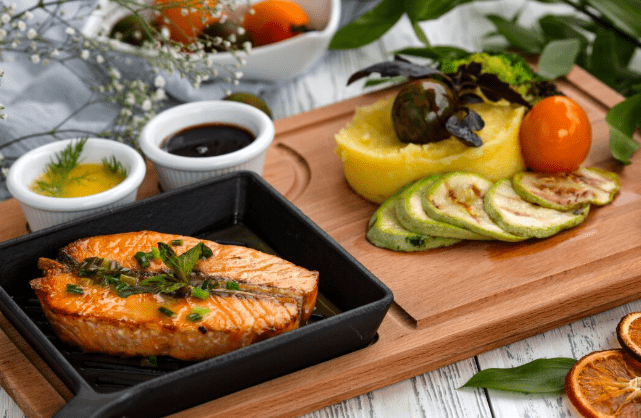
It has an almost antiquated quality. The air fryer, the one-pan miracle, the fifteen-minute dinner, and speed are all valued in today’s culinary culture. An hour of mostly hands-off oven time is required for slow-roasted salmon, which seems like a minor rebellion. After setting it, you leave. Perhaps you prepare a salad. Perhaps you don’t.
It may not be the most visually appealing method of cooking fish. However, it’s the one that continues to work even when you’re exhausted, preoccupied, and not paying close attention—dinner after dinner. That’s likely why food writers continue to write about it. In the kitchen, dependability is a luxury unto itself.
