

What happens to people when they eat by the harbor in Nafplion is difficult to describe. Despite decades of effort, the majority of travel writers give up midway and turn to adjectives they would never normally use. Cinematic and magical. Silently devastating. The town is situated on the eastern edge of the Peloponnese and faces the Bourtzi, a small island fortress. The entire layout seems almost too calm, as if it was created especially for long lunches that stretch into the evening.
The fishing port is not particularly impressive. That’s part of the ruse. On any given morning, there are perhaps a dozen small boats tied up along the quay. They are painted in the chalky whites and faded blues that are common throughout the Aegean, and the men who operate them have the slightly impatient appearance of people who have been working at the same job since they were teenagers. They unload sea bream, octopus, red mullet, and occasionally a bucket of urchins. By eleven, the kitchens behind the waterfront have already purchased the majority of it, and by one, it’s on a plate in front of you.
| Keys | Values |
|---|---|
| Place | Nafplion, Peloponnese, Greece |
| Coastline | Argolic Gulf, eastern Mediterranean |
| Known For | Fishing harbour dining, Venetian architecture, first capital of modern Greece |
| Signature Dishes | Grilled octopus, psarosoupa (fish soup), red mullet, sea urchin pasta |
| Best Season | Late April through early October |
| Notable Landmark | Bourtzi fortress, sitting alone in the bay |
| Cultural Recognition | Mediterranean diet listed by UNESCO as Intangible Cultural Heritage of Humanity, 2010 |
| Distance From Athens | About 140 km, roughly two hours by car |
| Local Population | Around 33,000 |
| Currency | Euro (€) |
Sitting there gives you the impression that you’ve discovered something that the rest of the world hasn’t yet accurately priced. The Ottoman and Venetian structures piled up behind the harbor give Nafplion, the first capital of modern Greece, a layered, slightly worn elegance that places like Mykonos lost years ago to Instagram and charter flights. In a lengthy academic essay on Mediterranean seafood, food writer Yanet Acosta and her colleagues argued that fish has served as a social marker in this region since ancient Egypt, and you can sense this history at the table even if you are unaware of it.
But it’s something more straightforward that appeals to people. It’s an octopus that has been grilled, charred around the edges, and dressed simply with lemon, olive oil, and a few dried oregano crumbs. It’s the waiter’s lack of hovering. The casual delivery of a small carafe of chilled local white. Around seven o’clock in the evening in late May, the light causes the sea to turn the color of worn metal, giving the Bourtzi a fleeting appearance of floating.
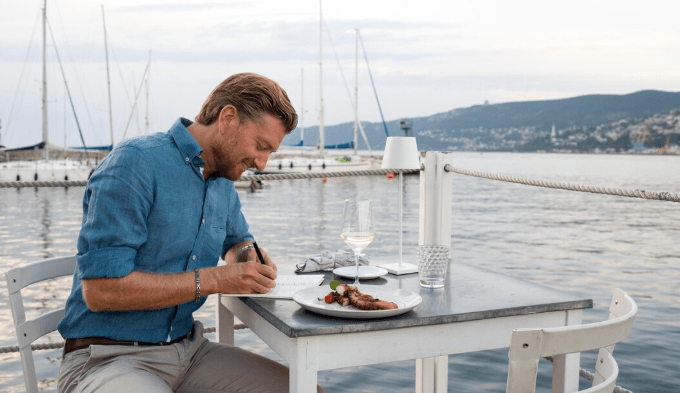
I’ve heard chefs from New York and London describe meals here in terms they would typically save for ten-fold more expensive tasting menus. One told me that the best plate of fish he had ever had was at a taverna in Nafplion whose name he couldn’t recall and didn’t really want to find again, though he was a little embarrassed to say it aloud. There’s a sense that giving it a name would ruin something.
It’s really unclear if Nafplion will remain this way. It was recently listed by The Times as one of the most beautiful springtime getaways in the Mediterranean, and that kind of attention tends to shift quickly. For the time being, however, it continues to be what it has been for a very long time: a small working harbor where the kitchens open, the boats arrive, and dinner is served with a view that no one has yet been able to adequately describe.
