

When a serious chef comes across an ingredient so honest that it disproves everything they believed to be true, a certain kind of silence descends upon them. According to most accounts, Ferran Adrià experienced something similar on the day he strolled through one of Copenhagen’s central fish markets. This is the kind of low-key, unglamorous place where the fish appear to have been swimming twenty hours ago and the cold comes off the ice before you even reach the stalls. which they were, for the most part.
You wouldn’t expect Adrià, the Spanish chef who spent twenty years at elBulli bending food into unimaginable shapes—foams, gels, spheres, powders, and textures that had no name before he invented them—to be stopped cold by a straightforward fish stand. However, the tale that has circulated in Copenhagen’s culinary circles goes something like this: he stood there, gazed at the produce, and remarked that it was one of the most memorable dining experiences he had had in a long time. Not a meal. It’s not a tasting menu. An ingredient, waiting on ice.
| Quick Facts: Copenhagen Fish Market (Fisketorvet Area & Kødbyens Fiskebar) | Values |
|---|---|
| Location | Copenhagen, Denmark — Central Food Markets and Meatpacking District |
| Most Famous Nearby Restaurant | Kødbyens Fiskebar — 15 years of sustainable seafood in the old Meatpacking District |
| Best Time to Visit | Early morning, Tuesday through Saturday |
| Notable Visitor | Ferran Adrià, legendary Spanish chef and founder of elBulli |
| Connection to Nordic Food Movement | Closely tied to the New Nordic philosophy — local, foraged, seasonal |
| Average Spend at Market | 80–150 DKK for fresh fish, depending on the catch |
| Nearby Landmark | Alchemist Restaurant — two Michelin stars, ranked among the world’s 50 best |
| Language | Danish, though most vendors speak fluent English |
| Getting There | Metro or S-Tog to København H, then a short walk west |
Over the past 20 years, Copenhagen has developed a culinary identity that other cities are still attempting to replicate. Named after the Danish words for “nordisk” and “mad”—Nordic cuisine—Noma opened its doors in 2003, and the idea it fostered quickly gained traction. By investigating fermented grains, foraged plants, insects, and tree bark—items that most professional kitchens wouldn’t have touched—the Nordic Food Lab went even farther. The remarkable quality of what simply emerges from the sea, the farms, and the forests of this region is what’s easy to overlook in all of that.
In contrast to Alchemist, where tickets for a five-hour, forty-course tasting menu at 4,600 DKK per person sell out in seconds and diners are served edible eyeballs under a planetarium dome, the fish market that seems to have recalibrated something in Adrià’s thinking isn’t a tourist destination. The market is the antithesis of spectacle. Like Danish mornings, it’s simple, functional, and a little bracing. Fishmongers in rubber boots, chalk boards with the day’s arrivals, a general absence of ceremony.
It turns out that the point is that directness. The traceability is what attracted Adrià and still entices chefs from all over Europe to spend time in Copenhagen’s markets before heading back to their own kitchens. Often, you can get a precise response when you ask where a certain fish originated. Not an area. a vessel. A date. Cooking is altered by that level of specificity, and it may also alter your perception of the true purpose of cooking.
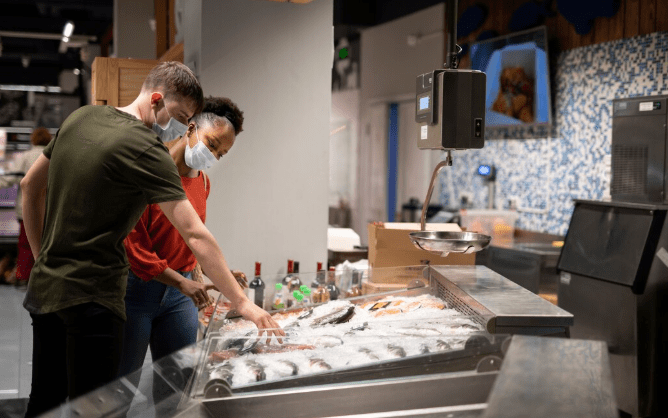
It takes very little preparation to visit the market on your own. For fifteen years, the Kødbyens Fiskebar in the former Meatpacking District has connected that same ethos—sustainable, precise, and seasonally honest—to a casual dining space. If you want to taste what the market’s best catch becomes in skilled hands, it’s a good place to start, especially in the evening. Arriving early during the day offers you the best selection and, on occasion, the opportunity to speak with vendors who are accustomed to inquisitive customers and happy to explain what’s worth purchasing that morning.
Standing there with the chilly air blowing off the display cases, it’s difficult to ignore the fact that this is the foundation of the entire discussion about Nordic cuisine. Not the theatrical presentation, the foam, or the dome, even though Copenhagen excels at all of those things. Beneath it is simply excellent fish that has been carefully prepared and sold by people who know that an ingredient doesn’t have to be altered to be exceptional. It seems that Ferran Adrià, who has spent a career demonstrating the opposite, saw the same thing. It’s not a minor observation.
