
When Perry Raso first used his bare hands to remove a littleneck clam from Point Judith Pond, he was twelve years old. He was not given a business plan. He was unaware that Narragansett Bay might be worth millions of dollars. He simply kept returning to the water year after year, picking up on its moods in the same way that some children pick up on a neighborhood—which corners to avoid and which to trust.
In this field, early intuition is more important than most people realize. The oyster aquaculture industry in Rhode Island did not happen to grow to a $9 million enterprise in 2024. It was made possible by those who viewed the bay more as a long-term partnership than as a resource. Raso, who went on to turn Matunuck Oyster Farm into one of the most well-known shellfish brands in the state, embodies something that is genuinely uncommon in American food production: a small business owner who strategically expanded without losing the plot.
| Profile: Rhode Island Oyster Farming — Key Facts | Values |
|---|---|
| Industry | Aquaculture / Shellfish Farming |
| Primary Species | Eastern Oyster (Crassostrea virginica) — 99% of production |
| Active Farms (2024) | 89 farms across Narragansett Bay |
| Industry Revenue (2024) | Nearly $9 million |
| Revenue in 2019 | $5.74 million across 81 farms |
| Total Aquaculture Area | 392.5 acres of licensed sites in Narragansett Bay |
| Peak Historical Output | 1.4 million bushels annually (early 1900s) |
| Key Challenges | Ocean acidification, biofouling, COVID-19 market collapse, climate change |
| Primary Market | Raw bar / fine dining restaurants (100% of sales) |
| Research Partner | University of Rhode Island Graduate School of Oceanography |
| Industry Body | Ocean State Shellfish Cooperative, Narragansett |
| COVID Impact Year | 2020 — sales dropped below 60% of typical summer volume |
| Federal Relief Received | $809,000 combined via USDA EQIP program (19 growers) |
Laziness is not tolerated by the water surrounding South County. A persistent enemy that silently stifles productivity while farmers sleep is biofouling, which is the gradual buildup of barnacles, algae, and invasive organisms clogging cage mesh. Researchers at URI have been measuring what farmers knew deep down: biology outperforms conventional equipment. In recent trials at Rome Point Oyster Farm, a more recent automated system called FlipFarm demonstrated labor cost reductions of up to 60%, and the difference in shell growth was visible to the unaided eye. It’s still unclear if that technology will become commonplace or remain a specialized advancement, but the direction is clear.
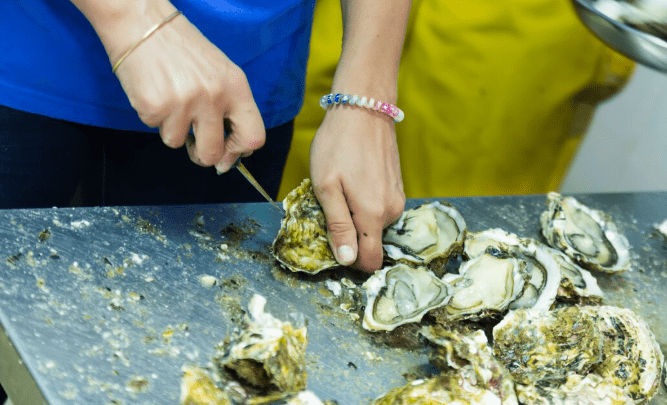
What the pandemic exposed about the industry’s vulnerability is more difficult to quantify. Graham Brawley, manager of the Ocean State Shellfish Cooperative, doesn’t have to look up the date March 11, 2020. Calls from wholesale clients ceased. Coolers full of unsold goods. The only viable market for Southern New England oysters was restaurants, which either closed or became skeleton businesses. That summer, sales never exceeded 60% of average volume. It was more like the floor vanishing than a market correction.
A combination of federal relief funds, unyielding patience, and a readiness to reconsider what an oyster can truly be allowed farmers to survive that time. On degraded reef sites, some planted oversized, unmarketable oysters to restore bay ecology and earn money through USDA programs. Although it wasn’t the strategy anyone had devised, it was successful. That improvisation contains a lesson: the most robust operations weren’t always the largest. They were the most flexible.
From a distance, it is easy to underestimate the additional layer of complexity that the climate picture adds. In order to create what she called the first thorough carbonate chemistry baseline for the lower west passage of Narragansett Bay, Jacqueline Rosa, a graduate student at URI’s Graduate School of Oceanography, spent eighteen months installing water sensors and gathering samples at a Wickford oyster farm. Her results are not yet concerning, but they are also not comforting. The very chemistry that enables oysters to form shells is disrupted by ocean acidification, and the effects intensify in the early stages of life when the animals are most susceptible.
Despite everything, it’s difficult to ignore the peculiar optimism that permeates this industry. In 2021, farmers who had witnessed a decline in sales in 2020 planted seed oysters once more. Researchers monitoring trends in acidification are also assisting farmers in selecting better equipment. Unbelievably, the bay continues to produce. And somewhere on a four-acre lease in Narragansett Bay, an oyster that was once hardly noticeable—smaller than a grain of sand, according to those who have held them—is developing into something valuable and, if the vision is realized, even more valuable.
