

When you walk past the shiny seafood counter in any well-lit grocery store in Seattle or London, you’ll find farmed salmon labeled with some variation of the word “responsible.” It looks legitimate. It is comforting. However, the label raises more questions than it answers for anyone who has taken the time to investigate the fish’s true origins and, more crucially, what it was fed. Now, that unease is subtly permeating the industry as a whole.
In a field full of green logos and ambiguous promises, the Global Seafood Alliance‘s Best Aquaculture Practices certification program has long been regarded as one of the more serious credentialing initiatives. Its new feed mill standards, which just finished a 60-day public consultation period that gathered feedback from business, academia, and non-governmental organizations, represent something truly different—an effort to put feed ingredient sustainability at the core of what “certified” truly means.
According to the standards, fishmeal and fish oil must come from stocks that haven’t been independently determined to be unsustainable and be completely traceable. In order for farmers to determine what the industry refers to as the fish in-to-fish out ratio—basically, the number of wild fish required to grow one farmed fish—feed producers will also need to disclose the inclusion rates of fishmeal and fish oil. The industry has long found it difficult to publicize that figure. It is a significant change to require its disclosure.
The seafood industry seems to have been keeping quiet about this problem for a long time. Aquaculture-related sustainability discussions have traditionally centered on local environmental harm, such as salmon pen effluent, mangrove clearing for shrimp farms, and the impact of escaped fish on wild populations. These worries are still present. However, the feed supply chain has mostly escaped the same scrutiny, dating back thousands of miles from any retail shelf to industrial forage fisheries. That is evolving.
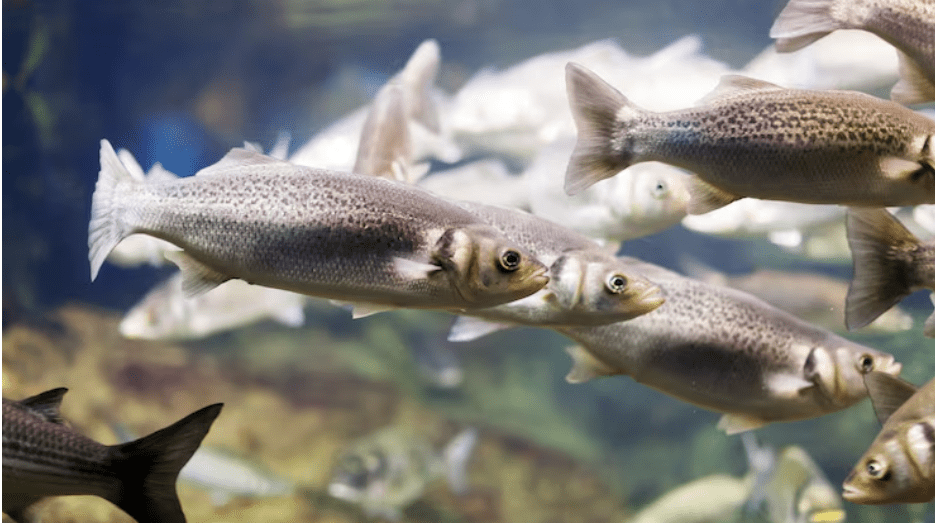
The FAO predicts a 75 percent increase in aquaculture production by 2040, according to Laure Boissat, who oversees the Oceans Program at the FAIRR Initiative, an investor network with over $75 trillion in assets. Before that expansion locks in practices that are anything but sustainable, she presents the opportunity for all stakeholders to define what “sustainable” really means. Whether the industry will advance quickly enough to meet that window or if the momentum will stall as it has in the past is still up in the air.
It turns out that retailers are under more pressure than they admit. Due to stock management concerns, Sainsbury’s in the UK already forbids the use of northern blue whiting in feeds for its salmon products. A number of other major retailers have their own internal operating standards that are kept under wraps and seldom disclosed. Sustainable aquaculture feeds were one of the top three issues for significant environmental organizations, according to a survey conducted by the Sustainable Fisheries Partnership among retailers, processors, and non-governmental organizations. That’s a startling degree of concern for a problem that most consumers aren’t yet aware of.
The investor layer is what distinguishes the current cycle of industry self-examination from earlier ones. Seven of the biggest seafood companies, including Thai Union, CP Foods, and Nomad Foods, have been pressured by FAIRR’s seafood traceability engagement, which involves 35 investors and $6.7 trillion in assets, to treat traceability as a material financial risk rather than a communications strategy. The problem was acknowledged by all seven. Only two have commitments that address both feed procurement and operations. Even there, there is still little implementation.
The difference between recognition and action is difficult to ignore. That gap cannot be filled by the GSA’s new standards alone. However, they do create a more precise baseline, which makes it more difficult for producers to assert accountability without being able to demonstrate their labor, all the way back to the waters where the feed fish were captured. The question worth keeping an eye on is whether that baseline stays the same or quietly softens as business pressures increase.
