

A certain type of hunger only becomes apparent after you’ve been moving for some time; it’s not the courteous, planned hunger of someone lounging by a hotel pool, but rather something more specific and animal. It detects scents before the mind does. It draws attention to a hand-painted sign or a smoke-drifting cart before the eyes have had a chance to fully register either. Anyone who has traveled through coastal areas and remained truly active can attest to how this feels. And anyone who has mostly stayed horizontal on a beach towel during those same trips has undoubtedly missed more than they think.
It’s not a subtle difference. Small trattorias tucked back from the waterfront can be found along the shores of southern Italy’s Salento, where people stroll between coves in the late morning heat. There, cavatelli pasta arrives with chickpeas and mussels, still steaming, paired with a glass of rosato that somehow tastes better at noon than it should. This version of Puglia is rarely encountered by tourists who are transported from resort to resort. It is there, but finding it is a little difficult.
Similar incidents occur in Peru’s coastal regions. Technically, the ceviche served at a highly regarded restaurant in Lima and the ceviche given to you in a paper cup next to a market in a fishing town are the same dish. However, their tastes are different. Being close to the catch is one aspect of that. A portion of it is the consumption of leche de tigre, that white, sharp liquid soaked in lime, while you’re still warm from walking, still slightly burned by the wind, and still paying attention. Physical exertion seems to recalibrate the senses in ways that are difficult to describe but simple to observe.
Finding the best fish tacos in the Baja region of Mexico is nearly impossible without first committing to some sort of movement. The open-faced versions, which consist of soft mahi-mahi tucked into a flour tortilla and finished with avocado or mango and a slick of ginger-lime dressing, are typically found at places that don’t advertise and are run by families who have been frying and folding since before the infrastructure for tourists arrived. Usually, you find it after passing the resort beach, the rental sunbeds, and the area where the pavement gives way to something looser.
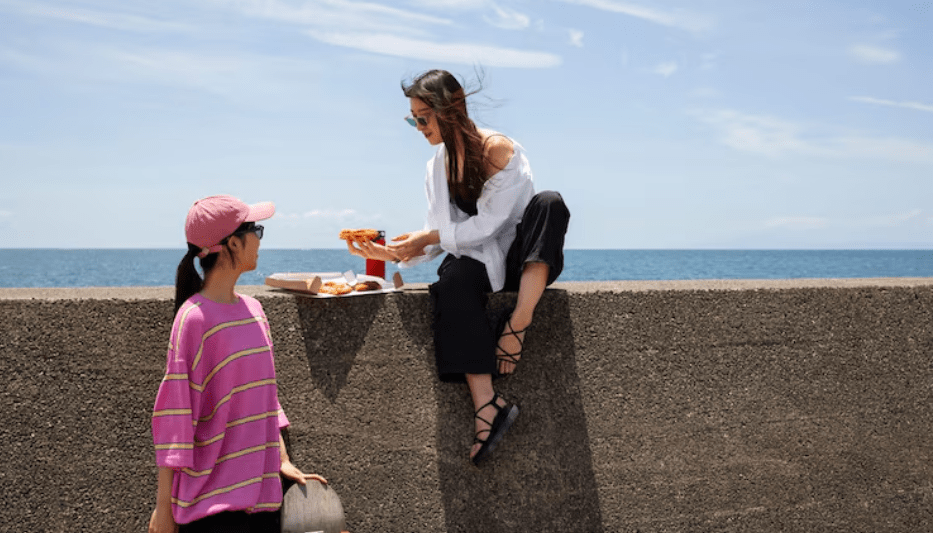
Movement is already a key component of Ecuador’s coastal cuisine culture. Fruit smoothies with a lot of maracuyá, known as batidos, are sold from roadside stands that are obviously meant for people walking by rather than standing still. Crunchy on the outside and steaming inside, corviche is a dense fried plantain pocket filled with peanuts and albacore that travels well in the hand and is consumed while strolling. Only when you’re covering ground does this type of food make perfect sense.
Travelers’ long-held intuition that gastronomic experiences in coastal regions carry emotional and epistemic weight beyond simple taste is increasingly supported by research on coastal food tourism. Food perception and memory are shaped by the interaction with place, whether it be the fishing culture, the proximity to the ocean, or the casual atmosphere of a shack without a menu. People are almost unintentionally brought closer to these dimensions through active travel.
In Jamaica, a beef patty from a packaged shelf doesn’t taste the same as one from a beachside fish fry shack after a strenuous morning stroll. Without any attempt at romance, grilled spiny lobster served on Nevis by a chef who got it that morning from a nearby boat becomes truly memorable. The food itself might be exactly the same as what you’d find somewhere else. It’s also possible that the majority of the effort is coming in on foot, a little windy, and with salt still on your skin.
The world’s coastal regions are home to exceptional cuisine. However, a large portion of it is located just past the stop for passive tourists.
