

Late October brings a certain type of cold along the Massachusetts coast that makes eating warm food seem more necessary than desirable. It is easier to understand why a bowl of fish chowder became something close to cultural identity in New England when you stroll through Gloucester or the old North End of Boston on a gloomy afternoon. Not a fad. Not a dish on the menu. a method of feeding people that predates the United States.
In 1751, the Boston Evening Post published the first known recipe for fish chowder. That is a truly astounding figure, not just a trivia point. Boston was still a British colonial city when that recipe was published. Most people are surprised to learn that the chowder came before clam chowder by almost a century. It didn’t. For a very long time, the only version of fish chowder that people were familiar with was the original.
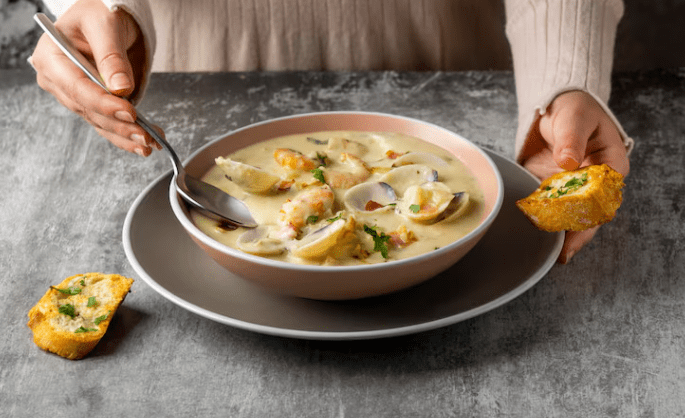
Clam chowder had subtly taken over by the early 1900s. Restaurants took advantage of it. Travelers requested it by name. The fish version was pushed to the back of menus and eventually removed from many of them completely. Although the exact reason why clam chowder captured the public’s attention so thoroughly is still unknown, its stronger, brinier flavor most likely played a role. When prepared carelessly, fish chowder is far less forgiving, less aggressive on the palate, and more reliant on high-quality ingredients.
The majority of recipes fail to mention that. The typical version served at mid-range coastal restaurants tastes very different from a traditional New England fish chowder made the old-fashioned way, which begins with a real homemade fish broth rather than chicken stock or a boxed seafood blend that has been sitting on a shelf for months. It has a depth that is difficult to explain without coming across as dramatic, but it is genuine. The clean, oceanic flavor of the broth is truly unmatched by bottled substitutes. Most people miss out on this extra step because they don’t take it.
The recipe itself is incredibly easy. Yukon Gold potatoes, onions, cod or another firm white fish, some bacon or salt pork, cream, and a broth made from the bones. As a shortcut, some versions include clam juice, which functions fairly well without the need for a complete homemade stock. The discipline needed is in restraint rather than technique. Avoid the temptation to add too much. The fish is worthy of being tasted.
It’s fascinating to observe how fish chowder endures through all of food culture’s obsessions, such as grain bowls, fermented foods, and hyper-regional street foods. Reinvention is not necessary. It’s not elevated by adding truffle oil or miso. The simplest versions, created by people who learned from someone older who learned from someone older still, are nearly always the ones that taste the best.
Eating a proper bowl of it on a chilly afternoon gives you the impression that some things just don’t need to be improved. that they arrived fully formed, ideal for their role, and have quietly withstood every effort by fashion and time to replace them. One of those things is fish chowder from New England. Without trying, it outlasted the fashions of the previous fifty years. It will probably outlive the next fifty years as well.
