

For a few years now, a decent deli’s canned fish area has been subtly becoming more fascinating. What was once a functional shelf has evolved into something more like to a specialty area, with premium Spanish conservas, Portuguese sardines in olive oil, and properly labeled smoked oysters. The seafood charcuterie board, or seacuterie if you’re willing to use the term in public, was a logical development for home entertainers who wanted something that felt more thoughtful than a typical appetizer spread because of this change in perceptions of canned and smoked seafood.
The flavor landscape is different from that of a meat-and-cheese board, but the build logic is the same. The reason seafood charcuterie works is that it pushes toward contrast: rich against something cold and crisp, smoky against acidic, solid against soft, and briny against creamy. Putting as much seafood as you can on a board is not the objective. The goal is to design a spread where each component enhances the flavor of anything close. That’s a different task, and it’s worth giving it some thought before you begin placing anything.
The structural anchors should come first. One bowl for the capers, one for the olives or cornichons, and one for the smoked salmon dip go down first. Before the larger elements are positioned, these establish the board’s layout and keep everything from spilling over into other areas.
The most consistently lovely focal point is cold-smoked salmon folded into rosettes; the spiral layers maintain their shape on the board and make up for the slightly higher price per dish. Smoked fish is less expensive and performs just as well. If you can get smoked scallops, they add a distinct tactile register that contrasts with the salmon’s fatty richness. They are harder, denser, and slightly sweet.
Instead of viewing canned fish as a financial compromise, it’s important to be honest about the fact that it has earned a spot on a board like this. Sardines in premium olive oil, smoked oysters packed in olive oil, or premium mussels in escabeche all have authentic flavor depth that can withstand anything fresh. The tins themselves can be opened and exhibited on the board as part of the presentation, which has become something of a design decision among those who gave it some attention. This is the visual advantage. It conveys the idea that the goods is worth showcasing instead of hiding.
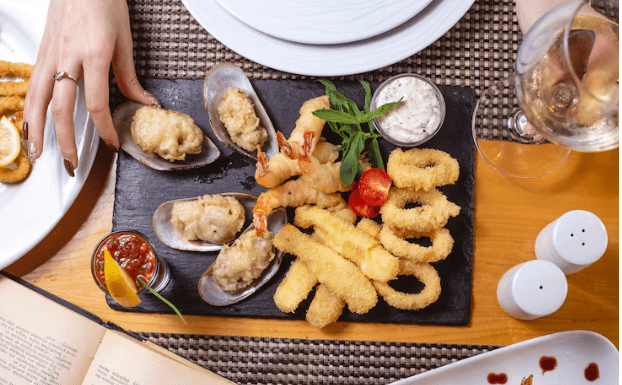
The occasion-level component is added with fresh or lightly cooked seafood. The things that visitors notice first and reach for with the most intent are poached shrimp placed in a curve around one corner of the board, a portion of crab leg cut into manageable pieces, or two or three freshly shucked oysters sitting on a small pile of crushed ice. Until the very end, keep them cold. Shellfish that has been left at room temperature for forty minutes is the fastest way to ruin a seafood board.
More than most people realize, the accompaniments are important. When paired with smoked salmon, seaweed-flavored puffed chips are truly superior to regular crackers. A simple cornichon can’t quite cut through the fatty richness of canned salmon like pickled red onion does. Avocado slices add richness without overpowering the dips. Additionally, anything sweet, like a little bunch of grapes, fresh berries, or a gentle drizzle of honey next to the smoked trout, does what sweetness always does with fish: it enhances the flavor of the savory component.
The seacuterie board seems to operate in part because it appears to be effortless. Cooking is not necessary for the majority of the ingredients. It takes roughly twenty minutes to assemble. However, a board constructed with respectable ingredients and arranged with some spatial intention—larger pieces dispersed over several portions rather than clustered in one place, gaps filled with capers and herbs, lemon wedges nestled where the color works—seems to need true expertise.
Fresh dill strewn over the salmon and a tiny bowl purposefully positioned in the middle for spent oyster shells are the finishing touches. It conveys that someone considered the experience before to the arrival of the guests.
