

Most recipes start from the incorrect place, which is why most lobster bisques taste like cream with a hazy seafood suggestion. They start with cooked lobster flesh, then add cream, broth from a carton, and a garnish. The outcome appears to be bisque. It tastes nothing like what it is supposed to. Since the flavor is found in the shells, the authentic version, which originates from homes where lobsters were harvested from the water rather than bought, begins there.
Everything in this dish starts with a good lobster stock. In terms of clock time, it is one additional step, as it sounds. However, the difference between a bisque that tastes delicious and one that makes people put down their spoons and ask what happened is almost all due to this additional step. When the shells are sautéed in oil until they become fragrant and bright red, they release fat-soluble chemicals that cannot be extracted by boiling alone. When they come into contact with the hot pan, their scent changes; it becomes deeper, more savory, and has a subtle sweetness that vanishes if you hurry past them. The soup is built on that moment.
The stock itself is simple: a halved head of garlic, rough-cut onion, carrot, and celery are added to the pot along with the sautéed shells. Deglazing the pan with a splash of dry sherry lifts the browned bits from the bottom and adds the subtle oxidized nuance that gives a sherry-based bisque a rounder flavor than one without it.
A teaspoon of peppercorns, a bouquet garni of bay, thyme, and parsley, water or good seafood stock, and white wine. After 30 to 45 minutes of slow simmering, the mixture is strained through a fine-mesh screen under actual pressure—not just poured through, but pressed—so that every drop of flavor remains in the strainer rather than being lost with the solids.
Before adding the flour, the bisque foundation is constructed separately using butter, diced vegetables that have been gradually softened until they become translucent, and tomato paste that has been stirred in and given a minute to caramelize. Most quick versions of bisques omit this traditional method; heating the flour in the fat before adding liquid results in a naturally thicker body after the stock is added and eliminates the taste of raw flour.
After the soup simmers to thicken and the strained lobster stock is gently stirred in, the immersion blender smooths and velvets the entire mixture. The heavy cream is added last, blended, and heated gradually. It is never allowed to boil vigorously after the cream is added, as this disrupts the emulsion and converts a silky bisque into something pale and gritty.
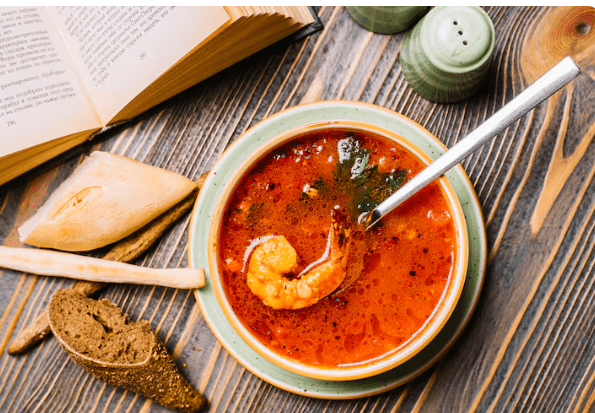
During the last two or three minutes, the lobster meat, which has been diced into bite-sized pieces, folds in and heats through without overcooking. This is one of the areas where the recipe most obviously deviates from the restaurant version, when the lobster meat is frequently introduced so early that by the time the soup is served, it is rubbery. When handled correctly, the pieces retain their texture and offer something to look for at the bottom of the bowl, which is a minor delight in a soup this rich.
