

When a restaurant consistently fails to open, a certain level of anticipation develops. The announcement is heard first, followed by the updated schedule, another delay, and finally silence. Some Catonsville residents had been waiting for almost six years by the time The Fishmonger’s Daughter finally had its soft launch on a Friday at the end of April. Some likely stopped counting.
The restaurant is located at 720 Frederick Road, inside a former Plymouth Wallpaper store that had previously taken the place of a century-old Heidelbach’s grocery store. When the Faidley family purchased the building in 2020, it had been vacant for years and was intended to become an outpost of their renowned downtown seafood stand in Baltimore County. What came next was either a love story or a cautionary tale, depending on your tolerance for construction misery. Maybe both.
There were actual, unrelenting delays. The renovations were halted almost immediately by a pandemic. Termite damage followed. Then the hard winters. Then electrical and plumbing repairs that no one had fully expected. Permitting comes next. The finish line always seemed to be getting closer, but then something moved it farther away. After spending more than ten years on this project, Damye Hahn, who co-owns the restaurant with her son Will, later claimed that there was one setback after another. She wasn’t lying.
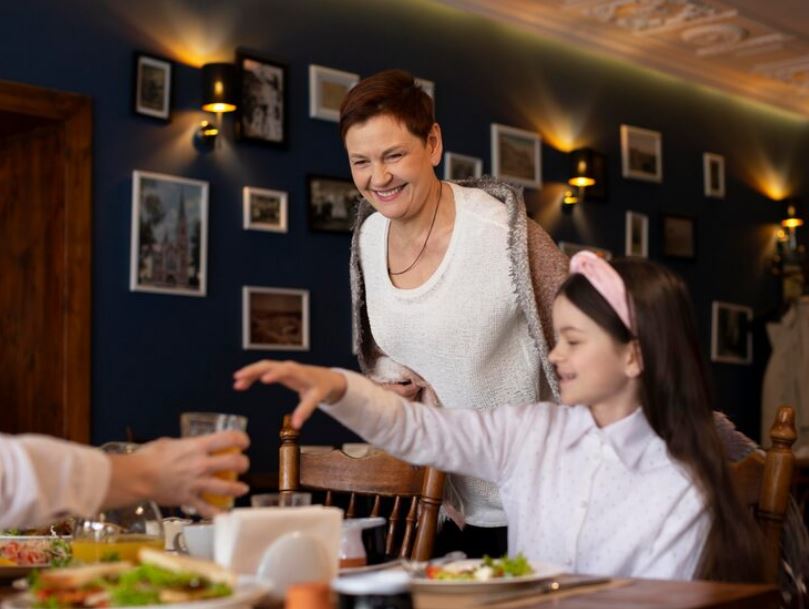
The finished space is noteworthy because it shows very little of that struggle. The tables in the dining room, which can accommodate 168 people, are made from 100-year-old heart pine beams that Hahn removed from the building’s original roof before it was demolished. Many of the tables were specially constructed by local woodworker Jason Dawson. Oyster shells from the original Faidley’s downtown location are inlaid into the surface of other tables made of maple that was salvaged from her father’s Ellicott City property. Hahn, her husband, and friends gathered the exterior shingles and gave them to Eric Magnuson, a Dundalk artist, who used them and salvaged copper from the storefront to create a 22-foot rockfish sculpture. Apparently, nothing was wasted.
This strategy has a subtle stubbornness to it. Hahn completed a number of restoration projects prior to this one while attending the Schuler School of Fine Arts. She was aware of the task at hand. Even so, it required about ten million dollars and six years. In the end, she created a 20,000-square-foot facility that houses the main restaurant, a basement shipping center, and the Plymouth Room, a second-floor event space that can accommodate 300 people. Dawn Moore, the first lady of Maryland, presided over the ribbon-cutting ceremony in June.
The menu has a strong Maryland slant. Every sauce, roll, and pastry is made in-house by executive chef Scott Bacon, who used to work at Magdalena at The Ivy Hotel. He also makes crab stock from whole crab bodies. A minimum of 75% of the crab product used each year must be harvested or processed in Maryland in order for the restaurant to receive the state’s True Blue designation. From the oysters to the cocktail syrups to the taps, Hahn has characterized it as being entirely Maryland-centric.
Hahn’s great-grandfather established Faidley’s Seafood, the company from which this entire enterprise is derived, in 1886. It rebuilt after surviving the 1949 fire that destroyed much of Lexington Market, and it went on to become one of the nation’s most well-known crab cake establishments. The current recipe was created in 1987. It’s possible that The Fishmonger’s Daughter intentionally carries the weight of that kind of continuity more than most new eateries would. The framework of the building is used to construct the tables. The original stall provided the oyster shells used in the furniture. The front door is directly on the route Hahn has driven her entire life.
Waiting for anything for six years is a long time. In the upcoming months, the dining public will determine whether the restaurant ultimately earns that specific timeline. However, it’s difficult to avoid the impression that the person who constructed this space wasn’t in a rush to make a mistake when you stand in a room where the very ceiling beams have been transformed into the surface you’re eating off of.
