

During the fifteen minutes it takes to set the table with mussels in white wine, people often think that this can’t possible work out as well as it seems. In another, better version of your week, the shallots are in the pot, the garlic is softening, the white wine is hitting the hot pan and creating steam that smells like a Thursday night in a French cafe. It seems too simple. Although there are variations of this meal around Europe’s Atlantic coast, the French and Belgian version, known as moules marinières, is actually simple.
Its simplicity is what gives it the appearance of a prank. This doesn’t require any sophisticated methods, exact timing, or equipment other than a big pot with a lid. Fresh mussels steam open fast and release their juices into the wine-and-butter base, resulting in a soup that tastes more sophisticated than a nightly kitchen. This is why the recipe works the way it does.
The order is important, but it is not delicate. Shallots and garlic are combined with a few tablespoons of butter and olive oil over medium heat, not high, as the objective is softening rather than browning, which would alter the broth’s flavor in a way that the dish doesn’t desire. If the shallots are finely diced, it can take a little less than three minutes. After that, the stock is added to a cup of dry wine, such as a Pinot Grigio or Sauvignon Blanc, without any oaking or barrel-like flavor.
The mixture is then brought to a boil for two or three minutes. Before the mussels get involved, this little reduction is doing a great job of concentrating the flavors and burning off the raw alcohol. The mussels are added next, the lid is tightened, and after five to seven minutes, the shells have opened and the kitchen smells much better than it did at the beginning of the evening.
Before buying mussels, there are a few things you should know. They should smell like the ocean, but not like ammonia; rather, they should smell clean, chilly, and slightly salty. The majority of fishmongers and supermarkets stock farmed mussels, which are ideal for this dish since they are dependably fresher and cleaner than wild-caught mussels.
The cleaning process is simple: scrub the shells under cold water, take each one’s fibrous beard off by grasping it firmly and dragging it toward the hinge, and throw away any shells that crack or remain open when tapped. The guideline applies in both directions: closed shells that fail to open after cooking go in the bin, as do open shells that don’t react to a tap before cooking. These don’t warrant more research.
It’s worth considering the optional heavy cream at the end. Wine, shallots, garlic, butter, parsley, and no cream make up the traditional Moules Marinières, which is lighter and possibly more sophisticated. The cream version is thicker, more opulent, and transforms the soup into something you may think about using a spoon to eat. Both can be justified.
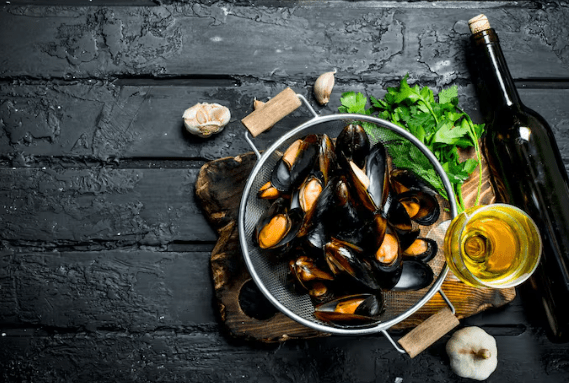
The choice is based on the amount of bread that is available because the bread is not a garnish; rather, it serves as a means of consuming the broth, which is the best component of the entire dish. Bread thick enough to withstand dipping, wide bowls, and an abundance of liquid ladled over everything. That’s how the dish should appear on the table. From an unheated pot, it takes less than twenty minutes to get there.
